

Widgets:
Testimonials
[testimonials]
[twitter username= »themefuse » items= »4″ title= »Twitter widget » post_date = »]
[flickr flickr_id= »51362473@N05″ items= »5″ title= »Flickr photostream »]
[latest_popular_posts]
[row]
[col_1_2]
By Michel Pierre-Louis
For the last few years, soccer fans worldwide have been waiting impatiently to find out where Brazilian sensation, Neymar, would play after his career with Santos. Sought after by the greatest clubs in the world, most notably Spanish giants Real Madrid & Barcelona; Neymar ultimately chose to play for the team that’s been considered as the greatest soccer team ever: Catalan giant – Barcelona.
In doing so, Neymar will be adding his name to the list of Brazilian greats that have previously donned the blaugrana jersey – such as Rivaldo, Ronaldo, Ronaldinho to name a few. He will be playing alongside the likes of Iniesta, Xavi and the already legendary Argentinian, Messi.
The expectations for Neymar and the club are astronomical. Barcelona has spoiled soccer fanatics worldwide, and sure enough, the club is expected to win every single one of its matches, in every single competition, by a large margin while playing soccer that is entertaining to the eyes. Add this latest star – Neymar – to the mix, and we can already envision “the end of the world” when this club loses – or tie for that matter – its first match.
Neymar is joining a club where great talents such as Alexis Sanchez, David Villa, and Cesc Fabregas – to name a few – have been struggling for playing time recently. One cannot be “good enough” to play for this club: you have to be the best at what you do. How will Neymar fit in?
Barcelona is a club known for promoting players from its development academy (La Masia), yet they were willing to bring in this 21 years old kid. How will he adapt to their playing style? How will he handle playing in Europe, where the game is much more physical? How will he handle a clasico at the Bernabeu?
So many questions to be answered; only time will tell. If the 2013 FIFA Confederations Cup is any indication however, Neymar is certainly up to the challenge. When all eyes were on him, he responded very well and delivered the Cup to the Selecao.
While many have criticized his diving antics, one cannot deny the talent that he possesses. As with any other previous campaigns, Barcelona will be expected to win everything they take part of, and opposing teams certainly have their work cut out for them. Neymar will be expected to play a huge role in such success. In a few months’ time, will be talking about one of the greatest flops in modern soccer history or will we be watching in amazement as this soccer club – and its newest star – take the world by storm? Stay tuned…
Andrew Farrell, the number one overall pick in the 2013 MLS draft, is a rookie defender for the New England Revolution. He talked to testing.haititempo.com about being the first overall draft pick and his early experiences as well as his future plan.
Q: When did you start playing soccer?
Andrew: I started playing when I was three years old in Louisville, Kentucky. My mom was my first coach, so I started pretty young.
Q: Who was your favorite player growing up?
Andrew: Really nobody famous – my brother was probably my favorite player to watch. He’s three or four years older than me and taught me everything I know. But, if I had to pick a famous player, I would have to say Alex Song who plays for Barcelona, I like him a lot.
Q: Do you think growing up in Peru helped you to become the player you are today?
Andrew: I definitely think so. I think just how soccer is everywhere there, I mean here it’s getting bigger in the states, but in every country but the states it is probably the biggest sport. I played after school and whenever I could in the parks and streets definitely helped me become the player I am today.
Q: At just 21 years old, being the #1 overall pick in the 2013 MLS draft, how difficult has it been to live up to the expectations that come with such selection?
Andrew: It is definitely nerve-wracking. I was nervous at first because you always want to make a good impression and live up to the hype, but I think the coaching staff here and all the players have done a good job at just letting me be myself and become my own player. It is hard to come in and start a lot of games for the team, but everyone has helped me just have fun out here. Expectations are obviously high, but I think it is just for the team to do well and when the team does well, I look good and everything looks a lot better. (laughs)
Q: How do you feel knowing that you play in one of the best defenses in the league?
Andrew: It speaks volumes to what we’ve done. It’s not just the back forward and the goal keepers, I think it is the whole team. Obviously we can’t defend well if our forwards aren’t scoring and our midfielders can’t press and you have guys like Bobby and Matt Reis behind you in goal. Players like AJ who are just biting at the chops to get some playing time, it makes everyone better. You have to perform 100 percent every day in practice to be able to start. Obviously, we have been playing well on defense and have only allowed 14 goals which is pretty remarkable, so we’ll try to keep building on that.
Q: What was going through your mind when you received your first red card in the league against the Whitecaps?
Andrew: It was a long-ball over our entire defense’s head, and I thought, we’re up 2-0, I don’t want this guy to score, especially because we had a pretty good shutout streak going. I mean, that wasn’t all that was going through my head, but I just had to stop him. I got really close to him to try to throw him off and he kind of tripped on my leg. I wasn’t really thinking, but some of the veterans said I should’ve just let him have the goal, we were up 2-0. If they scored, we’d still be up 2-1 and we were killing them, so you learn from those things. But still, it was my first red card ever so it kind of sucked.
Q: Who is the smartest player you have ever played with?
Andrew: I would probably either say Paolo Dipicallo who just got signed by Montreal or Scotty Caldwell. Scotty is probably one of the smartest players.
Q: What was your favorite moment while playing for Louisville in college?
Andrew: Probably when we went to the National Championship my Freshmen year. I got to play in the final against Akron and they beat us. Scotty scored, but playing in Santa Barbara was amazing because it was just the nicest weather in December. Just getting to the finals as a Freshmen was pretty cool and it was a good experience.
Q: Is coaching in your plan when you are done playing?
Andrew: Yes, I am hoping to coach or do something around the sport at some point. I love soccer so much and I am hopefully going to finish school within the next year or two. I would love to coach at the collegiate or club level somewhere, so that’d be kind of fun and something I’d like to do.
Q: What advice would you give to young players who want to become pro soccer players?
Andrew: What I have learned is that a lot of players get complacent once they reach a certain level. Everyone is good once they reach a certain level, but you have to have that work ethic every day, You just have to give 100 percent because there’s always going to be someone out there who’s better and working harder. Thank you.
—
Benson Petit-Clair for testing.haititempo.com
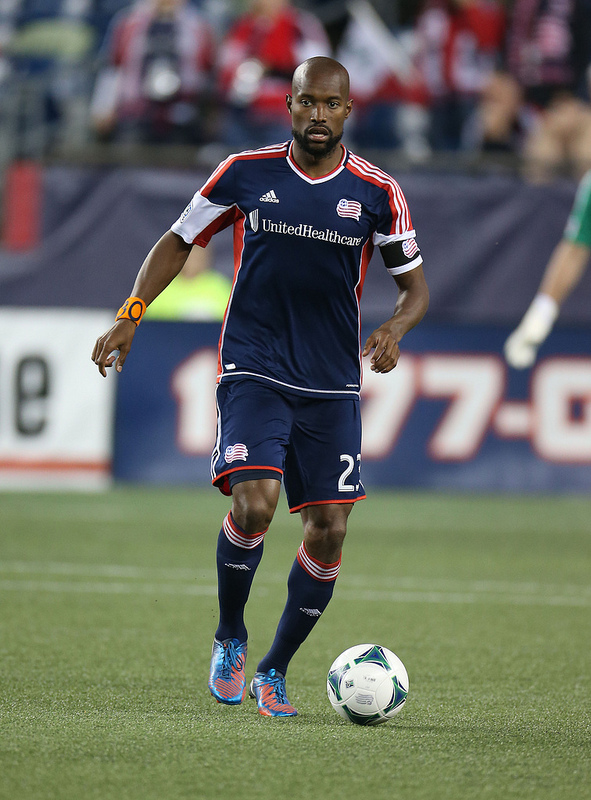
Jose Goncalves with the ball. Courtesy of the New England Revolution
Jose Goncalves of the New England Revolution is one of the best defenders in the MLS, he helps greatly stabilized the New England defense. He operates at the left-back posititon and also as a center-back. He provides outstanding leadership to the Revs as the Captain of the team. Jose talked to Haititempo.com about playing for the Revolution, Portugal and what it takes to become a professional soccer player.
1. Jose, how did you get started playing soccer?
“I was at home with my father and we were watching the Portuguese League. Benfica played and my father, as a young kid was a Benfica fan. When I watched that game, I realized that, wow, that’s really nice – the crowd and everything – and I had a dream to play soccer and to be a professional after this game. So that’s how I started playing soccer.”
2. Did you play any other sports growing up?
“I played basketball because my best friends used to play basketball and I play sometimes. I do other sports like hockey or tennis, but soccer was always my favorite so I ended up playing soccer.”
3. What is your favorite childhood soccer memory?
“I think when I was thirteen I went to San Siro, the AC Milan stadium and I was a big fan of Paolo Maldini. He was the captain at the time for AC Milan and I had a chance to see him play. It was amazing. I was shocked because the stadium was so big and I could see, for me, the best defender in the world and I think that’s my best childhood soccer memory.”
4. Who were some soccer role models you looked up to when you were coming up?
“Paolo Maldini from Italy, the AC Milan captain. He’s always been a model for me and Roberto Carlos from Brazil because they are always respectful on the pitch, out of the pitch and they work really hard. They’ve won so many titles with the club, with the country, and they’re really people you can learn from. They are not the kind of people who are arrogant or bad with other players or care only about themselves. They also care about the team and they’re really professional and I hope I can also have such a long career. They play until they’re 38 – 39 because they care about themselves and that’s why Paolo Maldini is my model.”
5. Tell us about your experience playing for Portugal, your national team?
“It was good. I started to play young with the Swedes. I was in Switzerland and I didn’t know if I would play one day for Swedish national team or not because I grew up in Switzerland, but my blood is Portuguese. For me, it was a big dream to play for Portugal because it’s a big country of football and I had the chance to play with Portugal in 2006, first under 21 and since then, I always played in Portugal. In 2008 – 2009, I was in Germany and I had my first pull up when Carlos Queiroz was the manager of Portugal so even if I was injured, I went. For me, it was amazing to be part of this group, such great players. This was also amazing because you have worked for so long and when you realize what you have achieved where you are, you must be proud about yourself. This is what football is all about for me – hard work to achieve what you’ve always wished.”
6. How do you motivate yourself to play at a very high level consistently?
“Every day, when I wake up, I think ‘it’s a new day.’ So even if I am not feeling very well – sick, tired – I say ‘Let’s go to the pitch and do the work. Let’s be focused for a couple of hours and after, you can go home and switch off.’ When I go home, I try to switch off. I have a dog. I go in the park with my dog and play with him, hang out with friends, go to the cinema, have a drink. I think it’s very important to switch off so the next day I am ready to motivate myself well. I have to go to work. I can say work, but it’s also a game. You must take this as a game because when I was a kid, I was going to play soccer as a game for fun and I’m still playing for fun, but it’s more serious now.”
7. What are the differences between the other leagues you’ve played in Europe and the MLS for you as a player?
“I’d say the difference between the MLS and the other leagues is that the other leagues, I think, have more experience. Right now, they are one step forward and MLS soccer is just starting develop now. I’m really impressed because the level is good in MLS and, of course, in Europe because they build such a great club, like Barcelona. They have such big stories so players go there and you know if you play for Bayern Munich or Barcelona, you’re going to be a good player because they have a good infrastructure. Here in MLS, every club has a good infrastructure, but they need more of this kind of experience, people who play at a higher level in other countries, to bring that into the MLS so they can develop better.”
8. What does it mean for you to be the captain of the team?
“It means a lot. I can say I feel a lot of the club’s trust in me – the manager, the players, and the staff – and for me, it’s a position that I take really seriously. As a captain, I must lead the guys, motivate the guys and also motivate myself and this is really important. Yes, I’m really proud to be at this position and hopefully we can achieve something this year. I came to the Revs with the mind that I can achieve something with them. Since I arrived, I believe that and I keep doing that.”
9. Who is the smartest player you ever played with?
“I think I can say Joao Moutinho from the Portuguese National team. He played in Portugal and now he’s in Monaco. He’s a really clever midfielder. He runs a lot and you think sometimes he’s tired, but he’s not and he’s really smart and he’s really clever. He plays some good balls and he’s really calm on the ball. I’ve played with a lot of smart players; I can say they are all smart. But I think he’s the smartest. He’s really quiet – quiet in the sense that he’s not rushing and he’s always in a good position to play the best balls.”
10. What advice would you give to young players who want to become professional soccer players?
“Work really hard. It’s not as easy as people think to be a soccer player. I cannot just buy some boots and go to a club and be a professional. It’s a long road. And be honest with yourself; respect yourself because you never know what’s going to happen the next day. Let’s say you pick up an injury, even if you’re the best player in the world, you can pick up an injury and that’s the end of your career. I think you must be the same as you were five years ago or before you turned professional. You must stay the same. Respect your friends and family. I think it’s very important, once you get the injury, that you have friends and family. I think just live the dream if you have the chance and enjoy football, playing soccer. You travel a lot, see new things and learn a lot from other coaches and people. That’s the best advice I can give them”
By Benson Petit-Clair for Haititempo.com / July 2013
Coach Antonio Israel Blake Cantero of the Haitian National team talks to the press alongside team Captain, Jean Marc Alexandre after being defeated bu
Après avoir décentralisé son organisation (AIPS Afrique, Amérique, Asie et Europe), le comité exécutif de l’Association Internationale de Presse Sportive (AIPS mondiale) a procédé à la formation d’une nouvelle commission baptisée : « Commission féminine de l’AIPS mondiale » dans laquelle se trouvent deux femmes issues du Nicaragua et de l’Equateur. Notre consœur, Shelove Perrin (Radio TV Caraïbes) et trois autres femmes natives respectivement de l’Uruguay, du Paraguay et du Mexique ont été choisies pour aider ces dames au sein de la commission de femme, branche AIPS de l’Amérique.
Au départ, elles étaient au nombre de huit, les femmes postulant pour intégrer la « Commission féminine de l’AIPS mondiale ». De ce fait, l’Uruguay et le Paraguay avaient soumis deux candidates. « Vu que ces pays aient au moins un membre (masculin) faisant partie du comité exécutif de l’AIPS de l’Amérique. Ce dernier n’a retenu qu’une candidate pour chacun de ces pays », a-t-on lit dans une note de presse envoyée aux associations nationales.
Ainsi, il ne reste que les candidates des pays comme : Equateur (Amérique du Sud), Nicaragua (Amérique Centrale), Mexique (Amérique du Nord) et Haïti (Caraïbes) pour représenter l’AIPS de l’Amérique dans la « Commission féminine de l’AIPS mondiale ». Pour départager ces candidates, le comité exécutif de l’AIPS (branche Amérique) avait nommé un jury composé de Carlos Julio Castellanos (Colombie), Andres Guevara (Mexique) et Jorge Torres Ocumarez (République dominicaine).
Après avoir étudié le dossier de chaque candidate, les membres du jury ont jeté finalement leur dévolu sur Lisette Hernandez (Nicaragua) et Esperanza Batallas Borja (Equateur). La première avait obtenu deux voix contre une pour la seconde. En plus de faire partie de la «Commission féminine de l’AIPS mondiale », elles sont à la tête d’une autre commission, celle de l’AIPS de l’Amérique. Les autres membres de cette commission sont : Leticia Bueno (Uruguay), Laura Morel (Paraguay), Karla Gabriela Gomez (Mexique) et Shelove Perrin (Haïti).
Joint au téléphone, la journaliste de Radio TV Caraïbes s’est dit flatter et prête à travailler dans le but de représenter dignement son pays. « Je n’ai pas de mots pour exprimer mes joies dans la mesure où j’ai été retenue pour intégrer cette commission. Cependant, je suis prête à faire des sacrifices rien que pour hisser notre bicolore en terre étrangère. Ce sera également, une énorme occasion pour moi de familiariser avec les autres consœurs du continent. Je compte apporter mon savoir faire et apprendre des autres », a répondu Shelove Perrin suite à la question : comment se sent-elle après cette nomination.
La journaliste de Radio TV Caraïbes a été choisie par le comité exécutif de l’Association Haïtienne de Presse Sportive (ASHAPS) pour ses connaissances sur les langues étrangères dans le but d’intégrer la « Commission féminine de l’AIPS de l’Amérique ».
L’AIPS de l’Amérique est présidée par le Paraguayen Gabriel Cazenave et est composée de vingt-huit (28) pays dont Haïti, et ce, depuis le 24 mai 2013 suite à la participation du Secrétaire général de l’ASHAPS aux premiers jeux de l’AIPS de l’Amérique, tenus à Medellin (Colombie) du 18 au 26 mai dernier.
Rappelons que cela fait plus d’un mois depuis que l’Association reine de la presse sportive en Haïti (ASHAPS) fasse son come-back au sein de la grande famille de la presse mondiale. Ainsi, après l’AIPS de l’Amérique (www.aipsamerica.com), c’est autour de l’AIPS mondiale (www.aipsmedia.com) de reconnaître et de réinscrire le nom de l’ASHAPS parmi ses associations nationales affiliées.
ASHAPS
Video: USMNT Head Coach Jurgen Klinsmann press conference after win over Costa Rica – 7/16/13
Les États-Unis ont battu le Costa Rica 1-0 mardi pour décrocher la première place du Groupe C de la CONCACAF Gold Cup. Les États-Unis qui avaient déjà accédé aux quarts de finale, ils ont obtenu la victoire, mais ils avaient besoin d’un match nul pour mantenir leur avance en tête du groupe. Jurgen Clinsmann, l’entraîneur américain a déclaré après le match qu’ils ne jouaient pas pour un match nul, ils ont joué pour gagner le match.
Avec son premier but international, Brek Shea a donné aux Américains leur troisième victoire en autant de matchs.
Shea a reçu une passe de son coéquipier Landon Donovan, puis il a couru vers le but où il a battu Patrick Pemberton, le gardien du Costa Rica avec un tir puissant à la 82e minute.
Les deux équipes n’ont pas créé beaucoup d’occasions de marquer durant la première moitié du match.
Donovan a donné aux États-Unis leur meilleure chance à la 12 ème minutes après la pause quand il a trouvé le ballon, mais il n’a pas fait un bon tir sur le gardien Pemberton.
Carlos Johnson a donné les Costariciens une belle occasion de marquer à la 78e minute avec sa tête après un coup franc mais le ballon a été renversé par le gardien américain Sean Johnson.
Celso Borges avait la dernière chance pour le Costa Rica dans le temps additionnel, obtenant sa tête sur un ballon, mais Johnson était au sommet de son jeu dans les buts pour les Américains.
Les États-Unis joueront El Salvador qui a terminé à la troisième place du Groupe B, en quart de finale, le dimanche 21 Juillet.
USA: Johnson; Parkhurst, Orozco, Goodson, Beasley; Holden, Diskerud; Bedoya, Donovan, Torres; Wondolowski.
Costa Rica: Pemberton; Miller, Gonzalez, Umana, Wallace, Borges, Cunningham, Diaz, Johnson, Tejeda, Granados, Arrieta
Pour leur dernier match du groupe B, les Grenadiers ayiti bayoont été battus ce soir au BBVA Compas Stadium par leur homologue du Salvador (1-0), mi-temps (0-0) suite à un but inscrit sur penalty par Rudolfo Zelaya (76′). Ainsi, pour espérer de se qualifier, ils doivent attendre le résultat de la rencontre qui mettra aux prises tout de suite après, le Honduras face à Trinidad & Tobago. En cas de victoire des Soca Warriors, Haïti sera éliminée. Dans ce cas, les Grenadiers ne sont pas maître de leur destin.
Lundi 15 juillet 2013
Gold Cup: BBVA Compas Stadium
Haiti – Salvador : 0-1 Rudolfo Zelaya 76′ P (Sal)
Haiti: Frandy Montrévil (GK/#1).- Jean Sony Alcénat, Judelin Aveska (#8), Méchack Jérôme (#3), Kim Jaggy (#19).- Monuma Constant Junior (#13), Jean Marc Alexandre (Cap/#16), Yves Hadley Desmaret (#15), Jeff Louis #7 (Peterson Joseph).- Jean Eudes Maurice #11 (Jean Jacques Pierre) et Léonel Saint-Preux #18 (Peguero Jean Philippe #10/ 13′)
ASHAPS
Foxborough, MA – Adam Moffat’s Second goal gave the Dynamo a victory over the New England Revolution on Saturday night at Gillette Stadium.
Moffat and the Houston Dynamo put an end to the Revolution’s four-game home shutout run by scoring right after halftime on a left footed strike from outside the box to the high center of the goal following a corner kick conceded by Jose Goncalves. Moffat’s first score which silent the in attendance, has the potential to be a goal of the year Candidate.
Prior to Moffat’s goal, the Revs did not allow a goal at Gillette Stadium since a 1-1 match on May 11th, against the New York Red Bulls. The Revs were coming off a 2-0 home win against the Earthquakes while the Dynamo ended a seven match winless streak on a 1-0 victory against the Philadelphia Union Last Saturday.
New England responded with a goal minutes later with Saer Sene receiving a ball in front of the goal line after the Dynamo GK Tally Hall punched the ball back to the playing field. Sene easily evened the score, scoring his second goal in as many match.
Adam Moffat found the net a second time in the in the 80th minute on a deflected strike from outside the box that smacked the post before it went into the net. That goal proved to be the difference maker on a hard fought battle by both squads.
Bobby Shuttleworth, the New England Revolution goalkeeper credited Adam for his efforts « The second one was – both of them were good strikes – he does really well. Especially the first one with his left foot. So credit to him. The second one he smashes it and I am just landing from trying to stretch out to tip it around the post and it just hits my back and goes right in » Stated Shuttleworth after the match.
Dimitry Imbongo who came in the second half to replace Chad Barrett picked up a red card after scuffling with Dynamo defender Eric Brunner. The red card left the Revolution undermanned while trying to respond Moffat’s goal.
New England Revolution (6-6-6, 24 points) will be on the road for their next three matches, starting on Wednesday to face the Colorado Rapids at Dick’s Sporting Goods Park then they will face Columbus Crew on Saturday. They will conclude the road trip at RFK stadium against DC United. Houston Dynamo Dynamo (8-6-5, 29 points) return to MLS action in two weeks when they host the Chicago Fire on July 27 at BBVA Compass Stadium.
Stats
New England Revolution: Bobby Shuttleworth, Chris Tierney (Juan Toja 86), Jose Goncalves, Stephen McCarthy, Andrew Farrell, Diego Fagundez, Kelyn Rowe, Scott Caldwell, Lee Nguyen, Saer Sene, Chad Barrett (Dimitry Imbongo 55)
Substitutes Not Used: Matt Reis, Darrius Barnes, Ryan Guy, Clyde Simms, A.J. Soares
STATS: Shots 8, Shots on Target 1, Corner Kicks 2, Saves 1, Fouls 10, Offsides 2, Passes 359 (77.7%), Possession 45.2%
Houston Dynamo: Tally Hall, Kofi Sarkodie, Bobby Boswell, Eric Brunner, Jermaine Taylor, Ricardo Clark, Giles Barnes (Warren Creavalle 92+), Adam Moffat, Andrew Driver, Boniek Garcia, Cam Weaver (Brian Ching 90)
Substitutes Not Used: Tyler Deric, Mike Chabala, Alex Dixon, Jason Johnson, Bryan Salazar
STATS: Shots 13, Shots on Target 3, Corner Kicks 4, Saves 0, Fouls 15, Offsides 2, Passes 432 (79.6%), Possession 54.8%
[/col_1_2]
[col_1_2]
Popular Posts
[/col_1_2]
[/row]
[divider]
Other Shortcodes
[row]
[col_1_2]
[newsletter]
Search widget:
[search]
[/col_1_2]
[col_1_2]
[autentificate]
[/col_1_2]
[/row]
[divider_dots_full]